The NWU GAZETTE
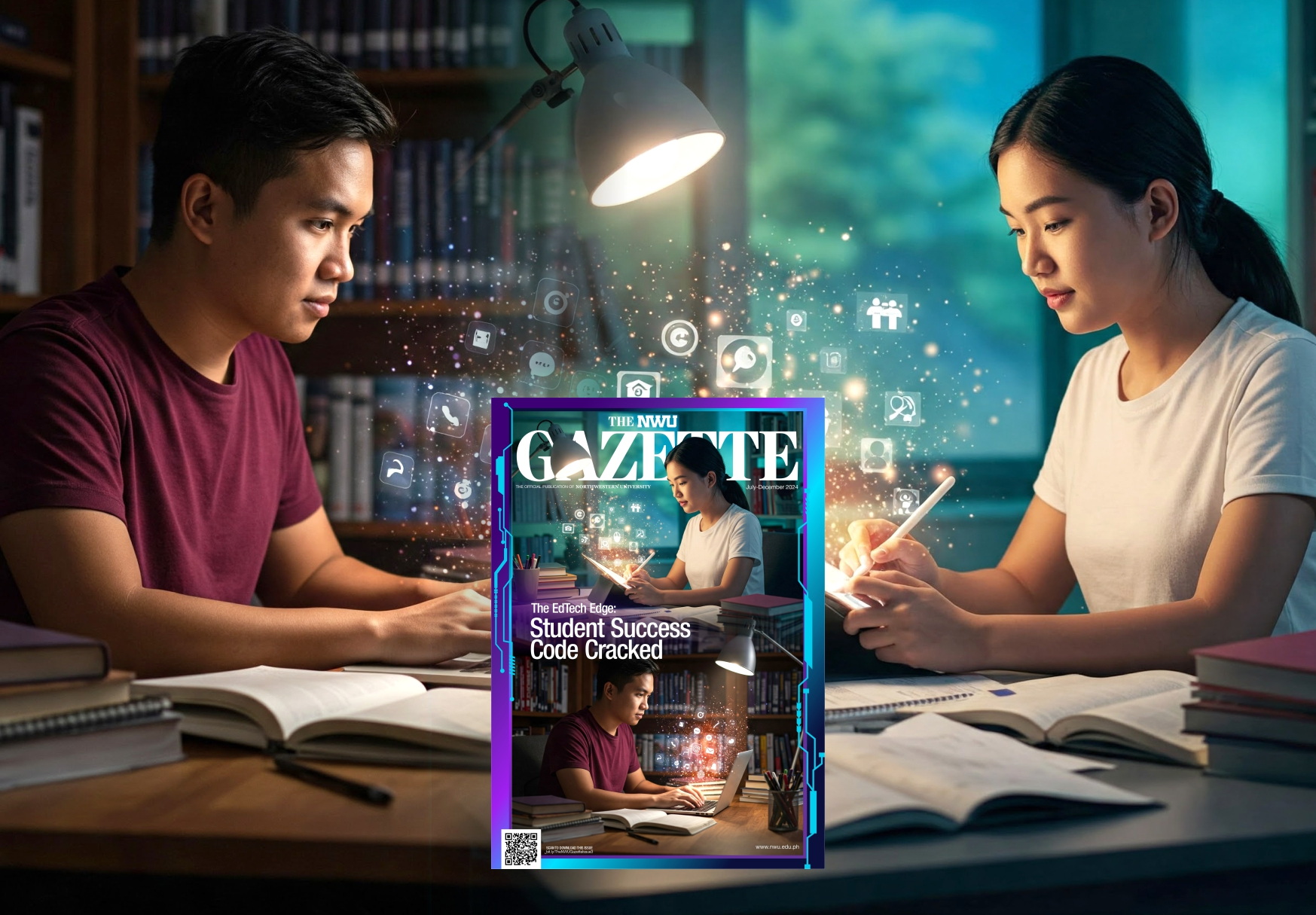
The EdTech Edge: Student Success Code Cracked
Northwestern University is strategically embedding a suite of modern educational technology platforms into its learning ecosystem, effectively cracking the code to student success in an increasingly digital and interconnected world. By integrating platforms like Coursera, the Wadhwani Foundation, Minerva, and even strategically utilizing Canvas, the university is empowering its students with diverse learning opportunities, fostering entrepreneurial mindsets, providing specialized industry knowledge, and enhancing overall engagement. This versatile approach, enriched by the direct experiences of students themselves, underlines the university’s commitment to cultivating globally competitive and successful graduates.
“From an outsider’s standpoint, I was just talking to some of my students who are now instructors in other schools nearby. One of the things that they have said was that the innovations imparted here or implemented here in Northwestern are revolutionary.
I would agree with that. I would say that it’s revolutionary that a school in the province has implemented such innovations, which take a lot of fearlessness and a lot of risk, but also that understanding that quality cannot be sacrificed. To sacrifice that would mean not being able to deliver what we have espoused in our vision and mission: globally relevant students and graduates,” stressed Prof. Maria Liza S. Nicolas, NWU Chairman of the Board and Executive Vice President “I think understanding and being on top of the technological innovations, understanding your market, and understanding the desired outcome allow you to stay abreast and to keep up with the trends. Be abreast of the competition and understand the market and the needs that they are requiring.”
For many students, the journey to expanded learning horizons begins with platforms like Coursera. This partnership has opened doors to a global classroom, offering access to a vast array of courses and specializations from renowned institutions worldwide. As Prof. Nicolas explained, “By leveraging the robust infrastructure and global presence of Coursera, Northwestern University aims to extend its distinguished academic offerings to a broader demographic.”
This initiative is already bearing fruit for students like Charlie Santos, a BS Hospitality Management student, who shared, “Taking courses on Coursera allowed me to explore subjects outside my major. It gave me a huge advantage during my internship.” This accessibility to diverse and high-quality learning resources empowers students to broaden their knowledge, acquire in-demand skills, and tailor their education to their specific interests and career aspirations.
Cultivating an entrepreneurial spirit is another key focus, significantly boosted by the partnership with the Wadhwani Foundation. This platform provides students with invaluable resources and training in entrepreneurship, fostering innovation and the development of viable business ideas. Prof. Jocelyn Evangelista, Dean of the College of Business Education noted, “Wadhwani helps our students how to do business, how to create product ideation, and then help them put that idea into reality.”
The impact on students is tangible, as evidenced by John Lester Quitog’s enthusiastic account: “Wadhwani completely changed my perspective. It wasn’t just theoretical; it was about practical application.” Another student, Allana Rose Quiambao, emphasized the platform’s accessibility: “The best part about Wadhwani was that it was free and open to students from all disciplines. It used to be challenging to be involved in developing a business plan, but Wadhwani made it approachable and exciting.” This focus on practical skills and real-world application empowers students to become innovators and potential job creators.
In specialized fields like maritime education, Minerva offers a tailored learning environment designed to meet the specific demands of the industry. This platform provides pre-loaded, industry-standard content, allowing instructors to focus on facilitating deeper understanding and assessing practical skills.
According to Mr. Gerome Castro, College of Maritime Education’s Assistant Dean, “The Minerva platform is a platform for maritime students. The only difference with Canvas is that in Minerva, the instructors don’t make the content. These are already content that are based on CHED Marina CMOs.” This ensures alignment with regulatory standards and relieves instructors of the burden of content creation.
Althea Damo, a maritime student, highlighted the benefits: “Minerva ensures that we’re learning exactly what CHED and Marina require. The content is always updated, so we know we’re getting the most current information. Plus, because the instructors aren’t spending all their time creating modules, they have more time to help us with our practical exercises and answer our questions.”
Another maritime student, Micoh Gante, appreciated the platform’s accessibility for review: “Unlike our previous system, Minerva allows us to go back and review materials from previous semesters. This is incredibly helpful when preparing for our comprehensive exams before graduation.” This focus on industry alignment and accessibility directly contributes to the success of maritime students in their rigorous academic and professional journeys.
While Canvas is no longer the primary LMS for all colleges within Northwestern, it still plays a strategic role in certain programs and initiatives, providing a familiar and versatile platform for course management and delivery. For some students, its user-friendly interface and collaborative tools continue to enhance their learning experience. “Canvas was really helpful for group projects,” shared Cheena Arzadon, a student in a program still utilizing the platform for specific courses. “We could easily share documents, discuss ideas, and submit our work. It kept everyone organized and on the same page.”
While other platforms may offer more specialized features for specific disciplines, Canvas provides a foundational structure for online learning and collaboration, contributing to student success through efficient organization and communication.
Collectively, these diverse educational technology platforms are empowering Northwestern University students with a comprehensive and dynamic learning experience. By providing access to global resources, fostering entrepreneurial thinking, delivering industry-specific knowledge, and facilitating effective collaboration, Northwestern is not just keeping pace with the digital age—it is actively shaping the future of education and equipping its graduates to thrive in a complex and interconnected world. The successes and positive feedback from students underscore that Northwestern University is indeed cracking the code to student success through its strategic and impactful integration of educational technology.
Download the e-copy: bit.ly/thenwugazettejanjune24
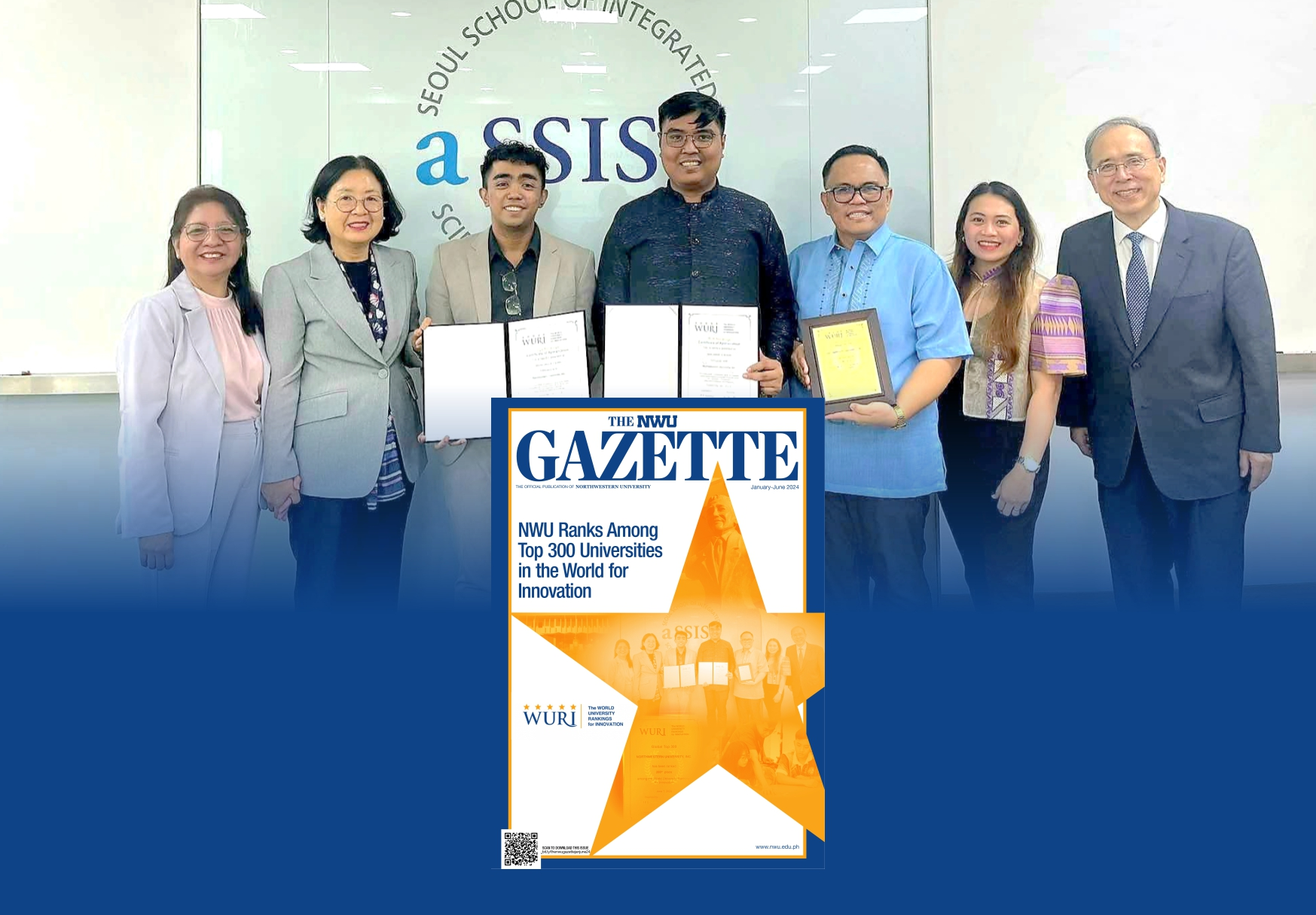
NWU Ranks Among Top 300 Universities in the World for Innovation
Northwestern University demonstrated its reputation as a global player in innovation, ranking Top 4 in Leadership, Top 21 in Student Support and Engagement, Top 40 in Industrial Application, and Top 289 Most Innovative University in the World University Rankings for Innovation (WURI) 2024. The results were announced during the Hanseatic League of Universities (HLU) Conference on June 7, 2024 in Franklin University, Switzerland.
WURI recognizes institutions that demonstrate a strong commitment to innovation and its positive impact on the communities they serve. These rankings assess higher education institutions’ real contributions to industry and society, highlighting innovative education, research, and engagement to society.
NWU’s FutuRise: Innovation through Futures-Centric Leadership (FutuRise) program achieved Top 4 in the Leadership Category. The award recognizes the university’s commitment to strategic foresight and a futures-thinking approach to education. The program is led by Atty. Ferdinand S. Nicolas, University President, and other distinguished administrators and faculty members.
In the Student Support and Engagement category, NWU’s Student Career Pathway Initiative Program ranked 21st among the top 100. This program, led by Ms. Shiela Navasca, Director of the University Center for Research and Development (UCRD), focuses on providing students with the necessary skills and support to succeed in their careers.
The Pre-service Teacher Assistantship and Readiness Training Program (PSTART) from NWU’s College of Teacher Education (CTE) was ranked Top 40 in the Industrial Application category. This program, led by Prof. Ma. Liza S. Nicolas, Executive Vice President, aims to enhance the skills and knowledge of pre-service teachers.
These achievements have significantly impacted NWU’s internationalization efforts. As a result, the university has been granted the UNESCO/UNITWIN Programme Chair on Anticipatory Governance and Regenerative Cities. Additionally, NWU has formalized a partnership with aSSIST (Seoul School of Integrated Sciences and Technologies) University in Seoul, South Korea, and SDG Management School in Geneva, Switzerland, to foster future academic and innovative collaborations.
“This recognition and collaborative opportunities ahead mark an exciting step forward in advancing academic excellence and institutional innovation,” said Ms. Navasca, who personally received the plaques of recognition awards in October 2024, in Seoul, South Korea, along with Dr. Charliemane Bullalayao, Vice President for Academic Affairs; Mr. Juan Jobelle Acosta, Dean of CTE; and Mr. Jezreel Larry Caunca, Foresight Coordinator, all of whom played key roles in the WURI submissions.
With a strong foundation in education and a dynamic focus on innovation, Northwestern University is well-positioned to continue shaping the future of education in the Philippines and beyond.
Download the e-copy: bit.ly/thenwugazettejanjune24
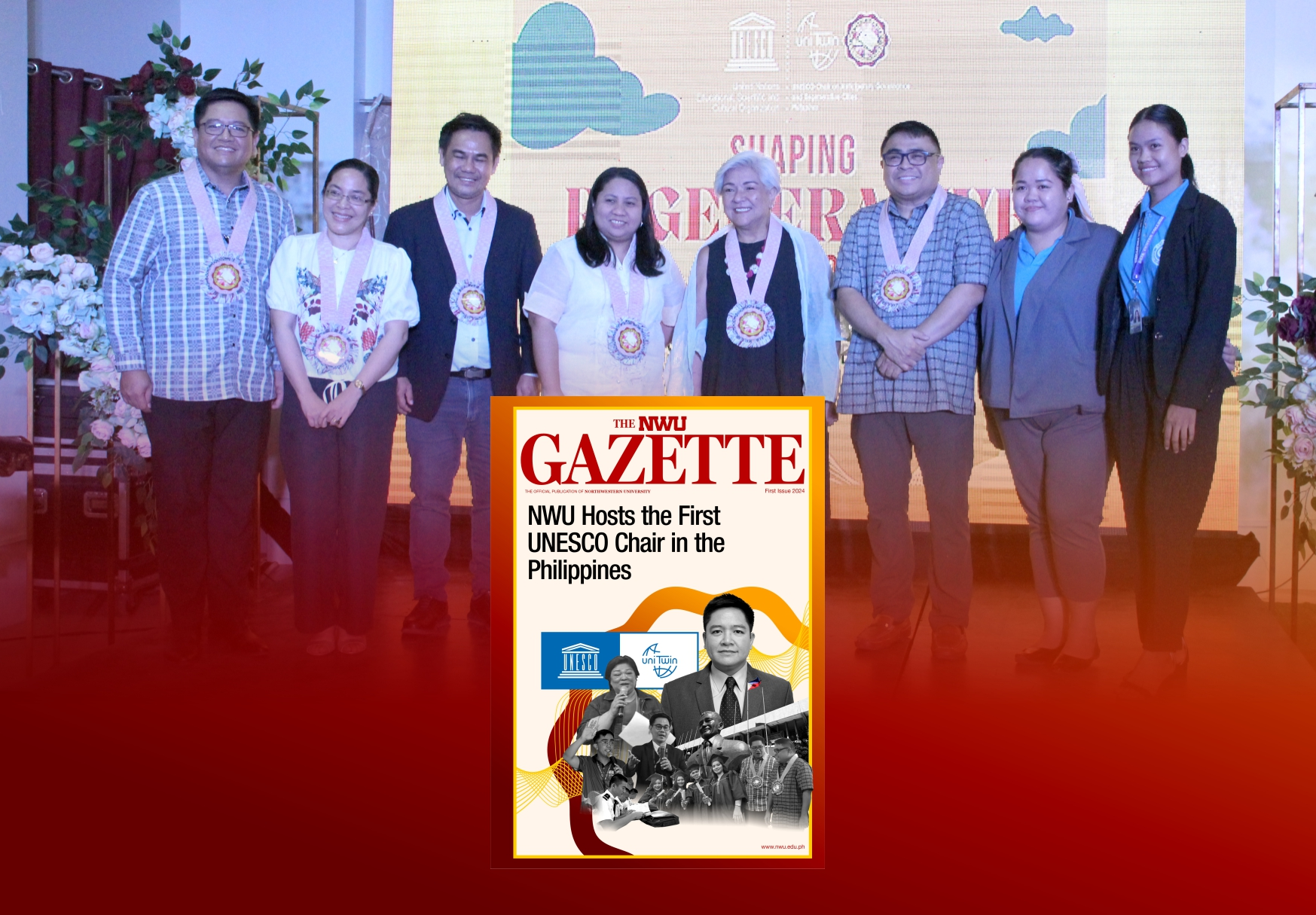
NWU Hosts the First UNESCO Chair in the Philippines
In May 2023, a Memorandum of Agreement was executed by UNESCO Director General, Audrey Azoulay, and NWU President, Ferdinand Nicolas, making Northwestern University the first host of a UNESCO Chair in the Philippines. According to the UNESCO website, “a UNESCO Chair is a project and a team at a university…that partners with UNESCO in order to advance knowledge and practice in an area that is a priority for both the institution and UNESCO.”
The university applied for the UNESCO Chair in November 2019 in which a detailed plan for the conduct of research, capability-building programs, and the building of a network of institutions advocating Futures and Anticipatory Thinking was submitted. The UNESCO Futures Chair granted to NWU focuses on Anticipatory Governance and Regenerative Cities. “We always study the past, but we have never had the opportunity to actually study the future,” Shermon O. Cruz, the NWU UNESCO Chairholder, said during the UNESCO Chair launch held on October 12, 2023 at the NWU International House.
Cruz continued, “The purpose of anticipatory governance is to give us the space and the opportunity to study the future and use it as…an asset to give the power to chart your own future.” Co-Chairing with him is NWU Executive Vice-President, Maria Liza S. Nicolas.
The launch was graced by Dr. Ivan Anthony S. Henares, Secretary General of the Philippine National Commission for UNESCO (UNACOM); Hon. Michael Marcos Keon, Mayor of the City Government of Laoag; Hon. Cecilia Araneta Marcos, Vice Governor of the Provincial Government of Ilocos Norte; Dr. Christine N. Ferrer, Director of the Commission on Higher Education – Region 1 (CHEDRO1); and representatives from different higher education institutions and organizations.
“The grant of the UNESCO Futures Chair provides for us a platform that broadens the scope of our reach. The UNESCO Futures Chair in Northwestern University…is offered in service for the Philippines and the Filipino people,” said Atty. Nicolas.
“With the support of UNESCO, we endeavor to empower different institutions and individuals with the capabilities to engage in futures thinking and strategic foresight to chart the course and engineer the future they desire for themselves,” he added.
Dr. Ivan Anthony S. Henares, UNACOM Secretary General, expressed, “Let us all help in shaping a future in which cities are resilient and flourishing. Governance is not merely reactive but anticipatory and commitments in sustainability are people-oriented. To all partners I enjoin you to participate in this transformative journey towards a brighter, more regenerative future for our cities and the rest of humanity.”
Among those who gave their video messages of support were former and current UNESCO Chairholders, as well as other experts in the field of futures thinking.
Download the e-copy: bit.ly/TheNWUGazetteIssue1