info@nwu.edu.ph

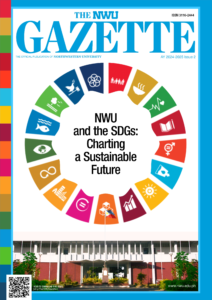
The NWU Gazette 04
AY 2024-2025 Issue 2
The NWU Gazette 04
How NWU Advances the SDGs through Education, Service, and Community Partnership
When the United Nations laid out the 2030 Agenda for Sustainable Development on September 25, 2015, academic institutions worldwide were compelled to rethink their role in shaping stakeholders toward a more equitable and sustainable world. At Northwestern University in Laoag City, Ilocos Norte, this objective evolved into a purposeful movement, where the Sustainable Development Goals (SDGs) are constantly being integrated into instruction, research, community outreach, and instructional planning.
The SDGs serve as an organizing framework that connects academic disciplines, community engagement, and operational decisions, ensuring the university’s contribution remains purposeful and traceable. This move reflects a broader trend among higher education institutions to translate global goals into local action and hold themselves accountable for the social, environmental, and economic footprints they leave on their communities.
NWU’s approach to the SDGs rests on three interlinked pillars: institutional commitment, curricular integration, and extension and community engagement.
Institutional commitment is reflected in strategic directions that emphasize responsibility, management, and community advancement. “Aligning with the SDGs enables Northwestern University to remain globally relevant, promote sustainability, and strengthen its commitment to social responsibility. It equips students to address real-world challenges, enhances institutional partnerships, and creates a culture of innovation and community engagement,” said Dr. Charliemane Bullalayao, Vice President for Academic Affairs.
Faculty members integrate the SDGs into lesson competencies, assessments, projects, and research activities. “I integrate SDGs 5, 10, and 16 in my lessons on Language and Gender by examining how language shapes perceptions of gender roles, power dynamics, and biases. This supports SDG 5 on gender equality and SDG 10 on reducing inequalities by addressing linguistic biases,” said Frances Ina Miguel of the College of Arts and Sciences. “Promoting inclusive language also aligns with SDG 16 by fostering fairness, representation, and stronger institutions. Overall, the course uses language to advance equity in schools and society.”
Similarly, the extension and community engagement transform concepts into action by allowing academic knowledge to translate into real-world solutions for local barangays and other localities, partnered institutions, and sectoral groups in Ilocos Norte.
Professor Harvey Ganal, Associate Dean of the Allied Health Sciences, stated, “We wanted to give back to the community, as we do not want to just lay these theories within the limits of the classrooms. They have to go beyond ideas.”
Last November, in celebration of World PT Day, an activity titled “Healthy Aging: Preventing Frailty and Falls” was conducted by the PT Department, led by Prof. Shiela B. Navasca and Mr. Francis Chua at SM Laoag City. It provided services such as free screening, including sensory pain, postural and frailty assessment, fall-risk evaluation, exercise prescription, safe balance exercise demonstrations, nutritional counseling, and free multivitamins. This initiative aligns with SDG 3, which focuses on good health and well-being.
Recently, championing SDG 4: Quality Education, NWU secured 1st Place in the short-term category with the project, “Functional Literacy and Numeracy Enhancement in Brgy. 58, Casili, Laoag City” of the College of Arts and Sciences, and 2nd Place in Long-Term Implementation with the initiative, “One University, One Village: The Whole-of-University Approach to Transforming Gawad Kalinga Talingaan.” NWU continues to create a space where no one is left behind in learning and progressing.
“We will continue to be an agent of change and a catalyst for a brighter future for these communities. It may not be something that we are expected to do, but we are open to lending our hands, for this is the heart of NWU. And of course, these would not be possible without the concerted efforts of all colleges and fellows, specifically Dr. Eric Parilla,” remarked Dr. Yolanda S. Lao, Director of the Center for Community and Social Development.
These pillars mirror NWU’s belief that making change is not limited to theoretical learning; rather, it must be demonstrated and shared.
Learning Beyond the Classroom: SDGs in Teaching and Research
Academic programs across NWU increasingly incorporate SDG themes, whether through public health education, livelihood training, environmental awareness drives, climate-related studies, or community-development research. Students learn not only the theories behind the goals but also the local realities they are meant to address.
Through thesis work, community-based research, field studies, and more so, the practicum programs, students engage with issues such as poverty reduction, health promotion, environmental protection, gender equality, and quality education. These activities cultivate graduates who understand the complexities of development and possess the skills to contribute meaningfully to society.
Community Engagement: Extending Sustainable Solutions to Local Communities
Northwestern University’s extension programs demonstrate how higher education institutions can make the SDGs tangible. University teams conduct health missions, literacy programs, livelihood workshops, disaster-risk awareness training, environmental clean-ups, and capability-building sessions in Ilocos Norte and neighboring provinces.
Each project often intersects with multiple goals. For example, a maternal health initiative can advance good health and well-being (SDG 3), quality education (SDG 4), and partnerships (SDG 17) simultaneously. This multi-impact approach showcases how sustainable development thrives through collaboration.
Why the SDGs Matter to Northwestern University and Ilocos Norte
As a long-standing educational institution in Northern Philippines, Northwestern University plays a vital role not only in producing graduates but also in shaping the region’s future. Through its adoption of the SDGs, the university creates an environment of responsibility and innovation, empowering students to become agents of change and positioning itself as a key partner in regional development.
The Sustainable Development Goals have created a ripple among students. Prof. Myra Michelle Guzman, Dean of Student Affairs, expressed, “I wish to reflect on the vital role that the SDGs are empowering our students to become true agents of change by embedding SDG principles to our stakeholders that learning is not only about academic achievement, but also about building a better future…for positive social impact with its knowledge, skills, leadership, engagement with communities, and values.”
The road to 2030 demands not just ambition but collaboration, discipline, and vision. With its growing portfolio of innovative initiatives and its unwavering commitment to meaningful community impact, Northwestern University stands poised to further strengthen its critical role as a regional and national leader in sustainable development in Ilocos Norte and beyond.