info@nwu.edu.ph
The NWU Gazette 05
AY 2025-2026 Issue 1
The NWU Gazette 05
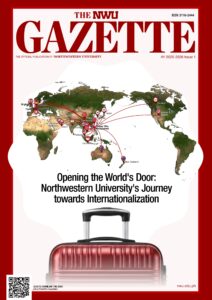
Opening the World’s Door: Northwestern University’s Journey towards Internationalization
It started with a handshake at a research conference. No memorandum of agreement waited on a desk. No formal delegation had been planned. Only two university leaders in a room full of academics, one of them a presenter and the other a speaker, finding themselves in the kind of conversation that quietly changes things.
That chance meeting between Northwestern University’s leadership and the president of Universitas Persada of Indonesia would eventually grow into one of the most productive international partnerships Northwestern has forged to date, now running three years strong with an active formal MOU, regular student exchanges, faculty mobility programs, and ongoing research collaboration. It is a story that, in the words of Dr. Eric Parilla, NWU’s Vice President for Research, Community, Social Development and Internationalization (RCSDI), “summarizes that collaborations and partnerships start with a simple gesture.”
That spirit of openness, of reaching across the table before the table is even set, has quietly defined Northwestern University’s internationalization journey. The road has not been without its challenges. The direction, however, has remained forward.
Beginnings
The story of how Northwestern arrived at that research conference, ready to extend a hand to the world, stretches back further than many within the university community might realize. According to Atty. Ferdinand S. Nicolas, NWU President, the roots of internationalization at Northwestern are intertwined with the institution’s very founding. Two of its founding fathers, Nicolas Nicolas and Maximo Caday, dreamed up NWU on a ship after being educated in the US. That shared experience of studying abroad left a permanent imprint on what the institution would aspire to become.
If there is one event that marked the shift from aspiration to institutional commitment, the President points to the Maritime programs of the late 1990s. The International Maritime Organization required that Maritime Education Institutions achieve ISO certification, making Northwestern’s maritime program the first part of the institution to operate under an internationally recognized management standard. By the year 2000, that momentum had carried through to the entire university, which earned certification under the ISO 9001:1994 Standard.
Certification gradually opened doors to more inquiries from foreign institutions. Sangmyung University of Korea, the first foreign institution with which Northwestern established a sisterhood relationship, sent a visiting professor to conduct English research in the early 2000s, along with exchange students whose credits were fully recognized by their home university. Students from St. Stephen’s University in Canada arrived for two-week cultural immersion programs, hosted by local families and attending lectures on industry, culture, and governance. Northwestern also joined the Association of Universities in the Asia Pacific.
Becoming a Priority
From an operational standpoint, Prof. Ma. Liza S. Nicolas, NWU Executive Vice President (EVP), recalled that internationalization only more recently became an institutional priority. Having been with Northwestern for close to two decades, she noted that the first order of business was streamlining operations: reorganizing layers of administration, engineering processes that could empower staff at every level to take initiative, and building a culture of institutional quality. Once those foundations were in place, the push outward could begin in earnest.
“Internationalization came in probably in the last five years,” she said. “It became a priority. We had an external office at one time where it brought in different programs, different linkages, that allowed us to see what we wanted to do, to get out of this region, mingle and collaborate with people outside.”
The catalyst that both the Executive Vice President and the President point to is the UNESCO Chair in Anticipatory Governance.
When Northwestern received it, the institution saw, as the EVP described it, how the world was “becoming smaller.” Membership in the World Universities Rankings for Innovation (WURI), growing student mobility opportunities through UNESCO networks, and the broadening of the university’s faculty connections all followed in its wake.
For Atty. Ferdinand S. Nicolas, that same recognition carried something beyond institutional prestige. It prompted a reckoning with a longer-standing disposition among Filipino institutions: the tendency to view anything international as automatically superior. Internationalization, pursued honestly, has challenged that assumption at its roots. “We can collaborate, we can compete even,” he said. The Philippines, he noted, has long been exporting talent across the globe, a sign of capability that has too often gone unclaimed as a source of national confidence.
When the President was invited to be part of a panel at World Futures Day at the UNESCO Headquarters in Paris, France, institutions across the globe reached out to Northwestern for collaboration in its aftermath. The world, it turned out, was ready to meet Northwestern more than halfway.
Steady Progress
The progress has been steady rather than dramatic. “Although our advancement in internationalization is very steady and subtle,” the VP-RCSDI acknowledged, “we are still progressing toward our goal of becoming a global university.”
Chief among its challenges is funding. International engagements, particularly face-to-face student mobility programs, come with costs that are simply out of reach for many students despite their academic readiness. Rather than letting this reality become a dead end, Northwestern adapted. Virtual and online mobility programs filled the gap, offering students and faculty exposure to international peers and curricula without the financial burden of travel. It was not the ideal solution, but it was a practical one, and it kept the momentum going.
The fulfillment, though, is what animates the Vice President’s telling of the story. International partnerships have not remained abstract institutional achievements. They have translated into real human experiences: students returning from Da Nang, Vietnam more confident than when they left, faculty members whose participation in international forums opened doors to speaking engagements abroad, and the campus’ infrastructure, from its classroom design to its common areas, that now reflects benchmarks drawn from the wider world.
The Universitas Persada relationship with NWU remains strong. Over three years, the two institutions have traded delegations, hosted joint webinars, and built the kind of familiarity that makes collaboration feel less like diplomacy and more like friendship. When Persada sent a delegation to Northwestern for the university’s internationalization activities last year, it was proof of a relationship that had grown roots.
Beyond individual partnerships, President Nicolas noted that voluntary accreditation and strategic institutional memberships have served as multipliers for NWU’s international reach. Membership in the Research Synergy Foundation, an initiative developed under Dr. Parilla’s direction, opened channels for collaboration with institutions Northwestern would otherwise never have encountered. ISO certification, Futures Thinking, and the UNESCO Chair formed the three pillars on which that broader network was built.
Futures Thinking
Among all the international programs that have taken root at Northwestern, Prof. Ma. Liza S. Nicolas is clearest about which one has fundamentally changed the way the institution plans. Futures Thinking, developed from the university’s UNESCO Chair in Anticipatory Governance, has been integrated into the general education curriculum, giving every student exposure to strategic foresight as an academic discipline.
For her, the clearest marker of successful internationalization would be a campus where global thinking is simply how people think, not a special program or an extra initiative. The vision is for all stakeholders engaging globally in the way courses are designed, in the aspirations of students, and in the composition of the student body itself, including foreign students who choose NWU because its reputation and curriculum have become globally recognized.
The next steps toward that vision are already in motion. The university is working to internationalize its curriculum, beginning with the Bachelor of Science in Business Administration, aligning course content with global standards in a way that can attract international students who might otherwise never have considered a university in northern Luzon.
Prof. Ma. Liza S. Nicolas frames the same challenge in terms of relevance. A curriculum that does not engage with global contexts cannot credibly invite students from beyond the country’s borders, and students from within the Philippines deserve to see their education reflected against the wider world. “You’ve got to take a look at your curriculum and make sure that it’s relevant to the times,” she said, speaking directly to the responsibility each college carries in making its course content globally literate.
Dr. Parilla concurs. “The global curriculum is the heart of internationalization. Because when your curriculum is aligned to the global context, the rest will follow.”
Seamless Global Transition
President Nicolas’ vision for what internationalization ultimately looks like is rooted in a seamless transition: the goal being an ASEAN educational landscape where credentials flow across borders, where a student can study in the Philippines and have their qualifications recognized in Singapore, Thailand, or Vietnam without friction.
The thread that holds all of internationalization together is quality. “We go through the process of voluntary accreditation,” Prof. Ma. Liza S. Nicolas said. “That’s what leads up to acceptance in the international market.” Quality is what makes the curriculum credible, the partnerships sustainable, and the university’s place in the global conversation secure.
Perhaps the most ambitious plan on the horizon is a twinning program, where students would spend three years at Northwestern and one year at a partner university abroad, earning two diplomas at the end of their studies. If realized, it would elevate what a degree from Northwestern means, offering more opportunities for the students.
NWU’s internationalization journey continues. Every step contributes to the building of this vision, showcasing that a regional institution can hold its own on a global stage. The door to the world is open. And through it stretches a vast, vibrant horizon, alive with opportunities that shimmer like stars across an endless sky.